
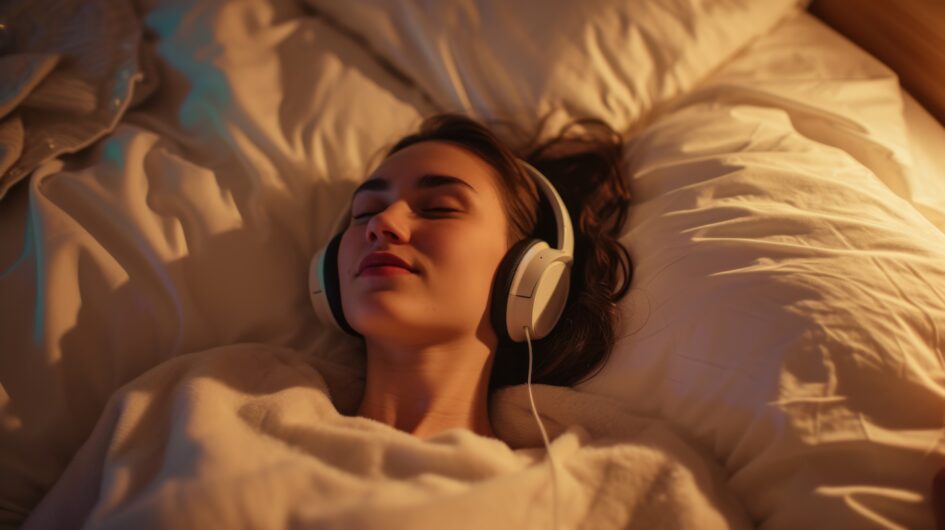
Although noise can often be a major obstacle to quality relaxation, not all sound is created equal — some types can help you sleep, focus and unwind more effectively.
White, pink and brown are perhaps the three most well-known varieties of colored noise, or distinct frequencies named after colors which vary in volume and pitch. While scientific research into the application of these sounds is still emerging, there is early evidence and theorization regarding possible benefits.
So, what’s the difference?
White Noise, aka Television Static
By far the most popular of the colored noise varieties, white noise is the result of playing all frequencies audible by the human ear at the same intensity. This makes for a high-pitched, hissing “shhhh” that could be compared to a steady waterfall or the hum of an air conditioner. By tuning out any background interference underneath this blanket of continuous sound, white noise can prove useful to light sleepers, as well as anyone who has trouble slowing down their thoughts and/or falling asleep at night.
White noise has been associated with a variety of positive effects. Primarily, there is research to suggest that the use of white noise can help improve overall quality of sleep, boost productivity and focus, and even address ADHD symptoms.
Pink Noise, aka Steady Rain
While pink noise also features a combination of all audible frequencies, it puts an emphasis on the lower end of the spectrum, leading to a deeper, softer and, ultimately, less intense sound than white noise. Due to its gentler tone, pink noise is sometimes considered a more relaxing alternative. It could be described as similar to the sound of wind rustling through leaves or waves lightly brushing the shore.
Similar to white noise, there is evidence to suggest pink noise could make a difference in cognitive performance and efficiency as well as addressing ADHD symptoms. Additional research is needed to form a definitive conclusion regarding the connection between pink noise and sleep.
Brown Noise, aka Rumbling Thunder
Also called “red noise,” brown noise is even more firmly planted in lower frequencies than pink noise. This results in a richer, more bass-like sound that’s especially good at muffling background noise, making it ideal for anyone looking to improve their concentration. The deep tones of brown noise are comparable to a rushing waterfall or a running shower.
Research suggests brown noise could help speed up the transition into REM sleep, as well as improve cognitive performance. Scientists hope to further define the relationship between brown noise and potential anxiety relief.
Interested in finding the frequency that fits your auditory needs?
You can explore YouTube for a wide variety of extended, ambient audio tracks, as well as any popular music streaming app. Though the differences between white, pink and brown noise might seem subtle, it’s clear from their research-backed effects that the power of distinct pitches and tones can be immense.
In a world populated by noise, finding the right sound may be just what you need to find a little extra peace and relaxation.
Sources:
“Brown Noise vs. White Noise vs. Pink Noise: Which Is Best?” Heather Jones, Verywell Health, verywellhealth.com, July 3, 2026.
“Cognitive performance, creativity and stress levels of neurotypical young adults under different white noise levels,” Mohamad Awada et al., Scientific Reports, Aug. 26, 2022.
“The Color of Noise and Weak Stationarity at the NREM to REM Sleep Transition in Mild Cognitive Impaired Subjects,” Alejandra Rosales-Lagarde et al., Frontiers in Psychology, July 16, 2018.
“The effects of white noise on sleep and duration in individuals living in a high noise environment in New York City,” Matthew R. Ebben et al., Sleep Medicine, July 2021.
“Sensory white noise in clinical ADHD: Who benefits from noise, and who performs worse?” Göran B W Söderlund et al., Scandinavian Journal of Child and Adolescent Psychiatry and Psychology, Nov. 23, 2024.
“Spectral Content (colour) of Noise Exposure Affects Work Efficiency,” Shih-Yi Lu et al., Noise & Health, Nov. 25, 2020.
“Systematic Review and Meta-Analysis: Do White Noise or Pink Noise Help With Task Performance in Youth With Attention-Deficit/Hyperactivity Disorder or With Elevated Attention Problems?” Joel T. Nigg et al., Journal of the American Academy of Child & Adolescent Psychiatry, August 2024.
“White Noise, Pink Noise, and Brown Noise: What’s the Difference?” Kara Mayer Robinson, WebMD, webmd.com, Oct. 21, 2024.